
Franklin County Court Records After Arrest
Franklin County criminal cases run through the North Carolina Judicial Branch. The county is in Prosecutorial District 11, Superior Court District 11, and District Court District 11. Franklin County also became an eCourts county on April 29, 2024, as part of the expansion that included Alamance, Chatham, Durham, Franklin, Granville, Guilford, Orange, Person, Vance, and Warren counties. That makes the North Carolina eCourts Portal the first online place to look for court records after a jail arrest.
The arrest and booking side is not the same record as the court case. The Franklin County Detention Complex may have booking details, custody status, bond status, and jail intake information. The court record is created or updated when criminal process and filed charges reach the Clerk and the case system. For custody and booking confirmation, use Franklin County jail inmate records. For booking photos, use Franklin County jail mugshots. The court file is where the formal charge path, hearings, case status, and disposition are tracked.
The Franklin County Judicial Branch location page identifies the local court districts, court-date tools, criminal calendars, and eCourts links.
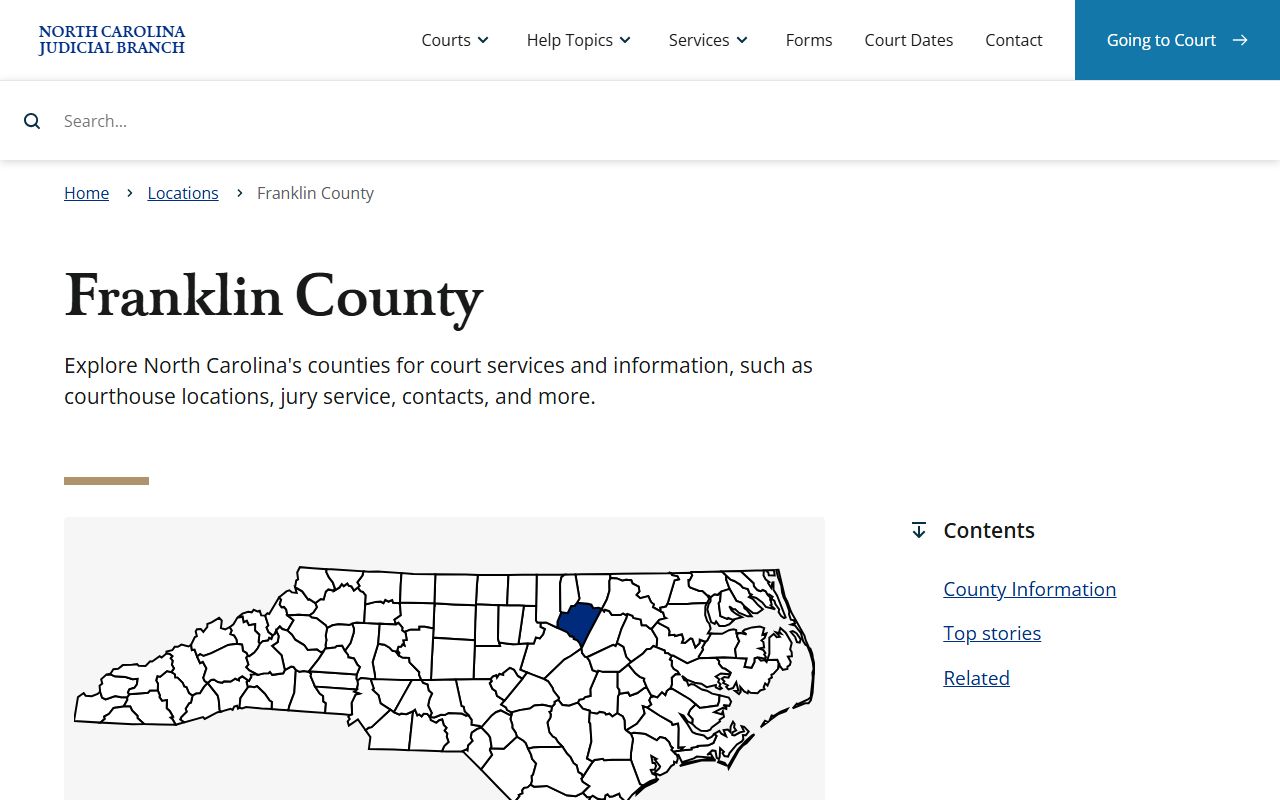
That official court page is the local court hub when an arrest has moved from jail intake into filed criminal case records.
Franklin Arrest to Court Path
The usual sequence is arrest, booking, magistrate or release decision, filed charge, court hearing, and disposition. FCSO's FAQ says that when a person is arrested, the person may be held for court, held under a bond, or released on a promise to appear. The FAQ also says a newly arrested person may speak after bond has been set by the magistrate. Those first steps are custody and release events. The case record develops when the charge or process is filed into the court system.
- Arrest or criminal process begins through FCSO, a municipal agency, state police, or another authority.
- Booking occurs at the Franklin County Detention Complex when local detention is required.
- The magistrate or court sets the first release path, such as promise to appear, bond, held for court, or another hold.
- The Clerk and court system receive or update the case through charges, citations, warrants, indictments, or related filings.
- The District Attorney reviews the case and may prosecute, amend, reduce, dismiss, or seek indictment on charges.
That sequence is why a jail charge label should not be treated as the final court charge. The arrest label may come from the officer, warrant, or booking paperwork. The court record shows what the prosecutor and court do with the allegation.
Franklin County eCourts Records
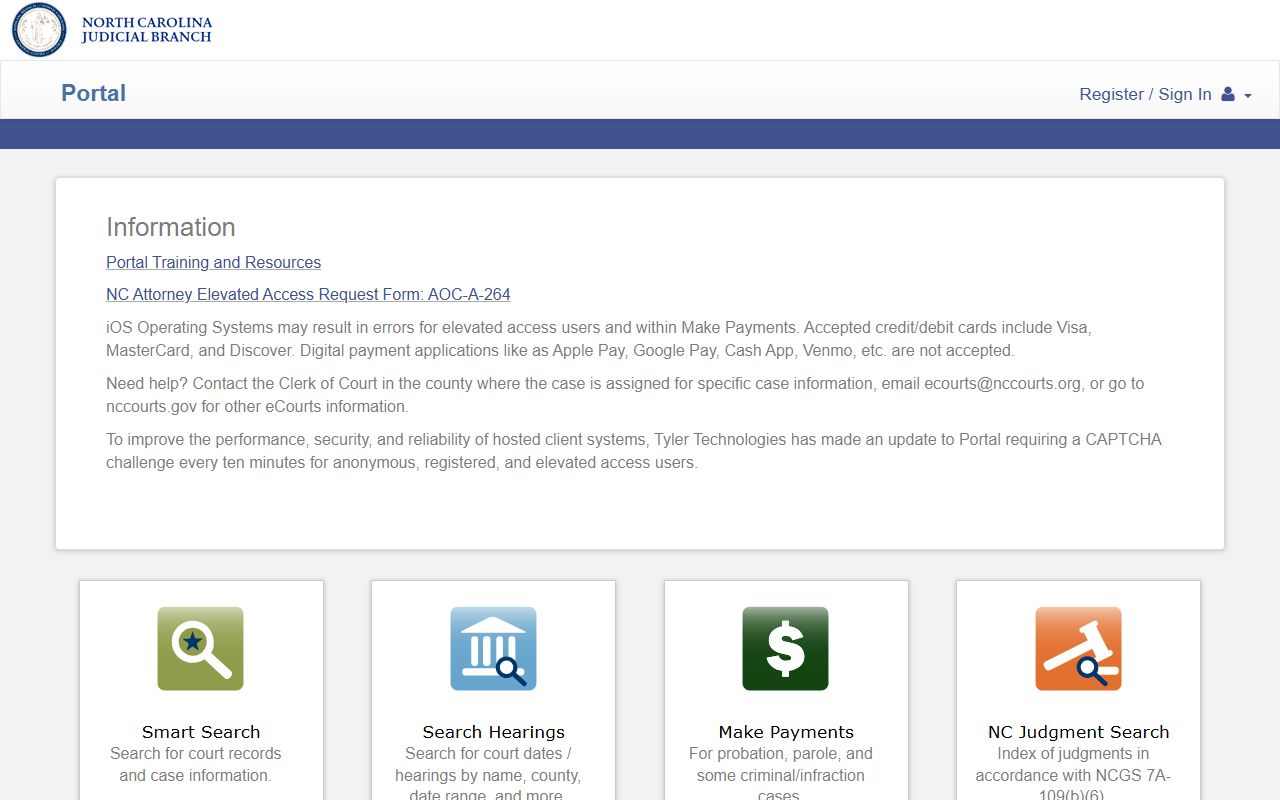
Use the North Carolina eCourts Portal for court records and case information after a Franklin County jail arrest. The portal landing page exposes Smart Search, Search Hearings, Make Payments, Judgment Search, Register, and Sign In. The research did not inspect every JavaScript field inside each portal tool, so the table reflects the visible portal controls and the Judicial Branch description.
| Field or Tool | Type | Required | Options / Notes |
|---|---|---|---|
| Smart Search | Search tool | Unspecified | Searches for court records and case information, usually by name or case number inside the portal. |
| Search Hearings | Search tool | Unspecified | Searches court dates or hearings by name, county, date range, and more. |
| Make Payments | Payment tool | Case or payment criteria required | For probation, parole, and some criminal or infraction cases; accepted cards are listed by the portal. |
| NC Judgment Search | Index tool | Unspecified | Judgment index under N.C. G.S. 7A-109(b)(6). |
| Register / Sign In | Account controls | Optional for basic public use | May support elevated or saved features. |
The eCourts Portal landing page is the statewide court-record entry point for Franklin County case lookup and hearing searches.
When the portal is hard to search, the Franklin County Clerk or the criminal calendars on the Judicial Branch page can help confirm court dates and older files.
Franklin County Clerk and DA
The Franklin County Clerk of Superior Court is the local court-record contact for older files, certified copies, and case records not easily found online. The Franklin County court directory lists the Clerk through the main court line at (919) 497-4200. FCSO's bond FAQ also references the Clerk at (919) 497-3030 for lost cash-bond forms or court-file bond receipt issues, with the Clerk address at 102 South Main Street, Louisburg, NC 27549.
The District Attorney is Mike Waters. Franklin County is part of North Carolina Prosecutorial District 11, which includes Franklin, Granville, Person, Vance, and Warren counties. The North Carolina Conference of District Attorneys profile lists the district office at Granville County Courthouse, 101 Main Street, Oxford, NC 27565, phone (919) 690-4860, fax (919) 690-4861. The Franklin County court directory lists a local District Attorney contact at (919) 497-4290.
Franklin County Clerk
102 South Main Street
Louisburg, NC 27549
(919) 497-4200
Use for court records, certified copies, court files, and older case questions.
District Attorney Mike Waters
Prosecutorial District 11
Franklin, Granville, Person, Vance, and Warren Counties
(919) 497-4290 local court directory contact
District office: (919) 690-4860 at Granville County Courthouse.
Franklin County Charging Documents
Court records after a jail arrest often turn on the charging document, not the jail intake label. North Carolina cases may involve a warrant, criminal summons, citation, indictment, or other process depending on the offense and court level. The research specifically highlights indictments, criminal summonses, and returned warrants as public court records under N.C. G.S. 132-1.4(k) unless sealed by court order.
| Document | Who Usually Starts It | What It Means |
|---|---|---|
| Complaint or warrant | Law enforcement, magistrate, or prosecutor process | Alleges an offense and may support arrest, custody, or required court appearance. |
| Information | Prosecutor | Formal prosecution document used in some cases without a grand jury indictment. |
| Indictment | Grand jury process | Formal charge in superior court felony matters unless sealed by court order. |
Franklin County Charge Status
Charge status is the case's current condition. A Franklin County court record after arrest may show a charge as pending, dismissed, reduced, amended, disposed, or convicted. The status can change more than once as the District Attorney reviews evidence, negotiates pleas, proceeds to indictment, or dismisses counts. The booking charge should be read as the starting accusation, not the final court result.
| Status | Plain Meaning |
|---|---|
| Pending | The charge remains open and has not reached final disposition. |
| Amended | The formal charge language or level changed after review or court action. |
| Reduced | The charge was lowered to a less serious offense or level. |
| Dismissed | The charge ended without conviction by prosecutor or court action. |
| Convicted | The case ended in a guilty plea, verdict, or other conviction disposition. |
| Disposed | The case has a final outcome, such as guilty, dismissed, not guilty, deferred, or another court result. |
Bond After Franklin Arrest
Bond and first appearance information helps explain why a person may be out of jail while court records remain active. FCSO says a person may be held for court, held under bond, or released on a promise to appear. North Carolina release conditions may include written promise, custody release, unsecured bond, secured bond, or conditions set by a magistrate or judge. A hold, detainer, probation matter, parole matter, outside warrant, federal custody issue, or immigration detainer can block release even when a bond appears on one charge.
| Release or Bond Type | How It Works |
|---|---|
| Promise to appear | Release based on a written promise to return to court. |
| Unsecured bond | No upfront payment, but liability if the person fails to appear. |
| Secured or surety bond | Money, property, or a bondsman/surety is required before release. |
| Cash bond | Cash is posted, with refund questions handled through court after disposition. |
| Held for court or no-bond hold | No immediate release until court, magistrate, or agency action changes the hold. |
Warrants and Returned Court Records
No official Franklin County NC active warrant search was located on the FCSO site. Warrant questions should use the sheriff, magistrate, Clerk, municipal agency, or eCourts channels, not unofficial lists. If a warrant causes an arrest, the jail booking may reflect the warrant or hold as a custody reason, but the court record becomes the better source once the warrant or case is returned and filed.
Under N.C. G.S. 132-1.4, arrest and search warrants that have been returned by law enforcement are public court records unless sealed by court order. The same statute identifies indictments, criminal summonses, and nontestimonial identification orders as public court records unless sealed. Active investigations and unreturned process may be treated differently, so a missing online warrant result should not be read as proof that no warrant exists.
Charges Versus Convictions
Franklin County court records after arrest can show accusations long before any conviction exists. A charge is the State's allegation. A conviction is a final outcome after a guilty plea, verdict, or another court result that counts as conviction. This distinction is essential when reading case records, employment disclosures, housing questions, or personal background checks.
| Charge | Conviction | |
|---|---|---|
| Stage | Accusation after arrest, citation, warrant, summons, indictment, or filing. | Final result after plea, verdict, or qualifying court disposition. |
| Proof Level | Based on probable cause or formal charging standards. | Based on guilty plea, verdict, or court finding. |
| Record Meaning | Shows what was alleged and prosecuted. | Shows the case outcome and may affect sentencing, supervision, or rights. |
Sealed and Expunged Records
Sealed and expunged records are not the same. A sealed court record is hidden from ordinary public access by law or court order, but it may still exist for limited official use. An expunction is a court process that clears qualifying matters from public record treatment. In North Carolina, N.C. G.S. 15A-146 covers expunction after dismissal or a finding of not guilty, and N.C. G.S. 15A-153 explains the effect of expunction.
| Sealed | Expunged | |
|---|---|---|
| Public visibility | Hidden from ordinary public access. | Cleared from public record treatment when the order applies. |
| How it happens | By statute, rule, or court order. | By petition or qualifying court expunction process. |
| North Carolina context | Returned warrants, indictments, and summonses may be public unless sealed. | Dismissed or not-guilty matters may qualify under G.S. 15A-146. |
N.C. G.S. 15A-152 also creates civil liability for certain private entities that disseminate expunged criminal-history information in violation of the statute. Official government records should be addressed through the court and agency that hold the record.
Restricted Franklin Court Records
Not every record tied to an arrest is public in the same way. Juvenile matters, sealed filings, confidential victim information, mental-health or medical information, and criminal-investigation records may be restricted. Police reports and booking records should be requested from the sheriff, county, or arresting agency. Court records should be searched through eCourts, criminal calendars, the Clerk, or the Judicial Branch public-records request process when the record is not otherwise available.
Use court records for formal charges and outcomes. Use jail records for custody, booking, and release facts. Use NC SAVAN/VINELink for custody notifications. Each system answers a different question after a Franklin County jail arrest.